
Last night, Bad Bunny joined that company, not through flash or excess, but by knowing his audience and delivering the right experience in the right place at the right time in history. That clarity made it one of the most impactful live music performances I’ve seen in years, if not ever.
When Bad Bunny stepped onto the field, it was clear this would not be a typical spectacle built around excess or shock value. Instead, it unfolded as a carefully constructed cultural moment that demonstrated a deep understanding of audience, identity, and setting. This was not a performance designed to overwhelm. It was designed to connect.
What made it powerful was not what was added, but what was chosen.
This performance wasn’t about spectacle for spectacle’s sake. It was about representation that felt real. Viewers who recognized these spaces felt seen, while those unfamiliar were offered an authentic glimpse into a culture without explanation or translation.
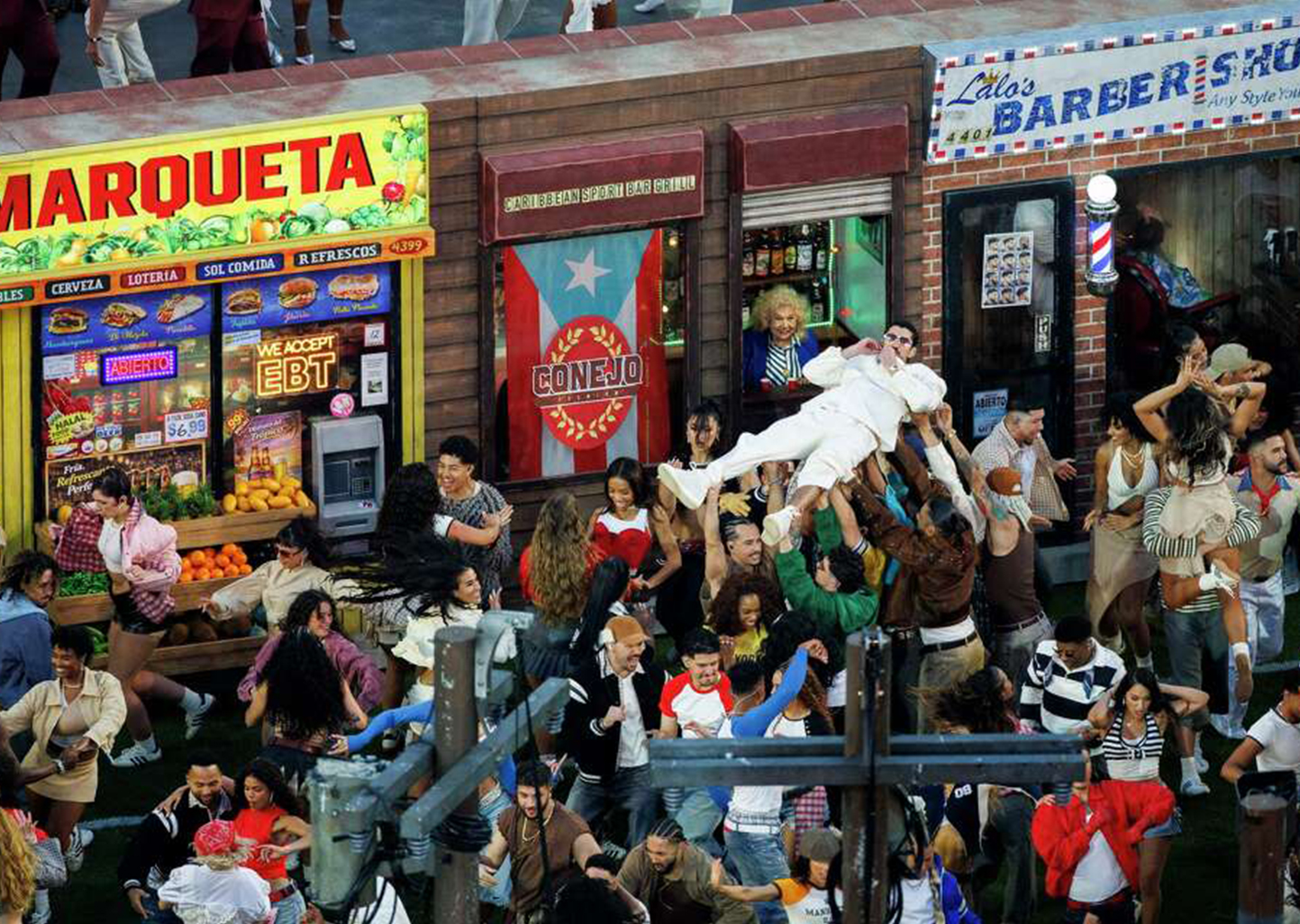
Bad Bunny didn’t dilute his culture for the Super Bowl audience. He leaned fully into it.
One of the most striking elements was the visual setting itself. Rather than abstract stages or futuristic designs, the backdrop evoked the look and feel of neighborhood bodegas, spaces deeply familiar to Latino and Caribbean communities. These are places of daily life, conversation, music, and movement. By bringing that imagery to one of the world’s largest stages, Bad Bunny grounded the performance in lived experience.
The use of color throughout the performance was equally impactful. Warm tones, saturated hues, and bold contrasts echoed the visual language of Caribbean streets, murals, and nightlife. These colors weren’t decorative; they were communicative. They reflected energy, resilience, joy, and community.
Rather than relying on dramatic visual changes, the scene’s color palette remained cohesive, reinforcing mood and rhythm. It created emotional continuity, allowing the audience to settle into the experience rather than being distracted by constant shifts. The result was a performance that felt immersive rather than overstimulating.
What tied the entire performance together was confidence, specifically the confidence of not needing to do too much. Every element served a purpose: the setting, the people, the music. It trusted the audience to engage without translation. And in doing so, it created something far more memorable than a fleeting spectacle.
Bad Bunny’s Super Bowl halftime show worked because it was built on understanding. Understanding of his audience. Understanding of culture. Understanding of what the moment required, and what it didn’t. Rather than chasing universal appeal, the performance was achieved organically. By staying rooted in identity and intention, it connected across demographics without losing its center.
On the biggest stage in entertainment, Bad Bunny proved that the most impactful performances aren’t built on excess; they’re built on understanding.